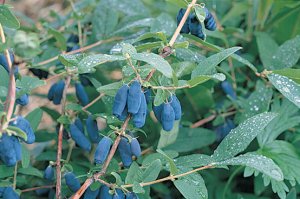
Blue Honeysuckle Seeds 25 Count Lonicera flava Native Blue Lonicera flava, Native Honeysuckle, is a desirable landscape vine native to the US and should be allowed to prosper for the first two to three years of germination for spectacular results. Native Honeysuckle is a very showy vine with unusual foliage and bright flowers that turn reddish as they age. This plant grows up to 15 feet tall with opposite, sessile, ovate leaves. Shiny cluster of bright orange red fruit in the fall. This delightfully unusual flowers of wild Blue Lonicera flava, Native Honeysuckle bloom in April, May, June, and July in moist shade along rocky slopes in woods, in ravines, and along bluffs ) It has tubular flowers and the same type of foliage as the coral honeysuckle. Grow this vine in sun or part sun. The blooming period is from March to June with perhaps a few flowers later in the season. Trailing and twining woody vine with branches to several feet long. Stems Smooth, tan, becoming gray with shredding bark, sometimes with adventitious roots at the nodes of branches touching moist soil. Leaves Opposite, pale- to dark green above, somewhat gray-green below, glabrous, elliptic to obovate, 5-12 cm (2-4.7 in) long and 2-6 cm (0.8-2.4 in) wide, sessile. The uppermost pair perfoliate, forming an oblong structure subtending the inflorescence. Inflorescence A terminal pair of 3-flowered sessile cymules. Flowers Bluish white to deep blue, bilaterally symmetric, 2-2.5 cm (0.8-1 in) long, blooming in late Spring. Fruits Reddish-orange, 5-10 mm (0.1-0.2 in) in diameter, ripening in late Summer or early Fall. Growing Your Honeysuckle Plants: Blue Honeysuckle prefers full sun, but will tolerate partial sun, and even some light, afternoon shade. Once established, Honeysuckle needs only moderate watering, unless the summer is very dry. If the planting area is properly prepared and mulched, your Honeysuckle will be satisfied with a light annual application of a balanced fertilizer (10-10-10) at the beginning of the growing season, and then once again in the middle of the blooming season. They are usually sold in 1-gal. containers beginning in early spring. Honeysuckle should be planted in early spring, as soon as frost danger has passed. Prepare the planting area as for any perennial and set the plants a minimum of two to three apart. (2 feet if you are using them as a ground cover) Water the plants thoroughly, and follow up with repeated soakings until the plant shows signs of new growth. Mulch the plant with heavy cover of leaves, to protect the roots from freezing as well as to conserve moisture in the summer. When your plant has finished blooming, you can prune for shape. (Only lightly prune plants until they are well established at about 2 to 3 years old) If your Honeysuckle is to be grown on a trellis or an arbor, put it in place before planting, to avoid damaging your vine. Then plant your Honeysuckle 6-12 in. away from the support to allow enough growing room for developing stems. The vines should be tied to their support using strong, stretchy materials that won't cut into growing branches. Strips of old nylon hosiery work very well for this. Loop each tie into a figure 8, with the crossed portion between the stem and the support to keep stems from rubbing or being choked.